
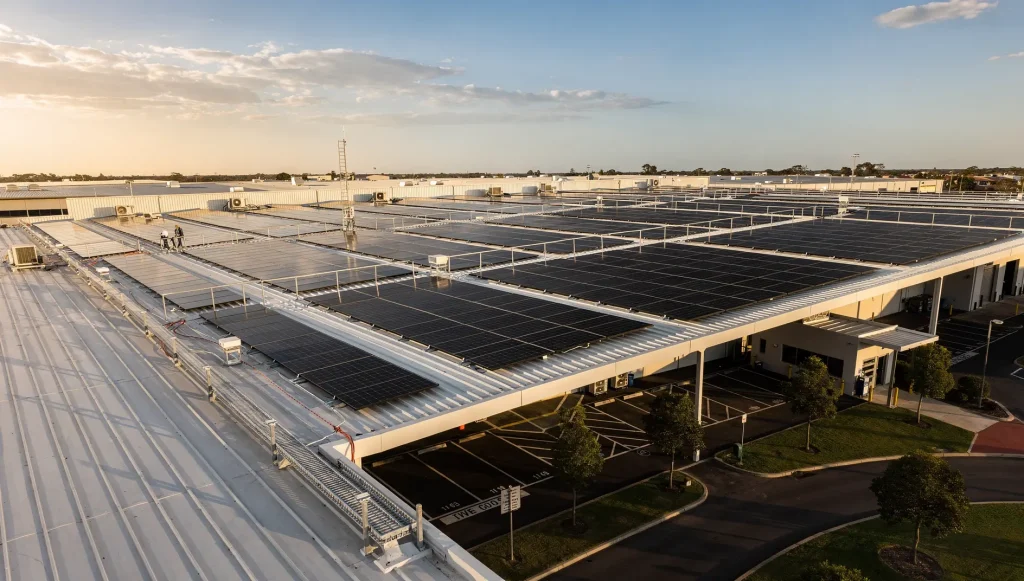
If your business electricity bill has grown noticeably larger in recent years without a matching increase in what you actually use, you are not imagining it. Grid charges in Western Australia have risen consistently, and they affect almost every line item on a commercial power bill. For many Perth businesses, commercial solar installation has become a practical response — not a speculative one — to the ongoing pressure of rising energy costs.
What Grid Charges Actually Are
When people talk about an electricity bill, they often focus on the usage rate — the cents-per-kilowatt-hour figure. But a commercial electricity bill is made up of several distinct charges, and usage is only one of them. Network charges, service charges, demand charges, and feed-in or export-related costs all contribute to what a business pays each billing period.
Grid charges refer broadly to the costs associated with delivering electricity through Western Power’s network to your premises. These include fixed daily supply charges and variable network usage fees. Even if your business reduces consumption, the fixed components continue to apply. That matters because it means efficiency alone does not fully protect you from rising grid costs — you need to change where the energy comes from, not just how much you use.
In WA, Synergy sets the retail electricity tariffs for most small to medium commercial customers, while larger businesses may be on contestable market contracts. Either way, the network costs embedded in those rates have trended upward over time, driven by infrastructure investment and the cost of maintaining the South West Interconnected System (SWIS).
How Solar Directly Reduces Grid Dependency
A commercial solar system generates electricity from sunlight during daylight hours. Any power your business uses from that generation instead of drawing from the grid is power you do not pay the grid rate for. This displacement of grid consumption is the primary financial mechanism behind solar for businesses.
Perth’s solar resource is exceptionally strong. The city consistently records among the highest solar irradiance levels in Australia, meaning panels here produce more energy per installed kilowatt than in most other capital cities. For a business that operates during daytime hours — offices, warehouses, retail, manufacturing, hospitality — the overlap between solar generation and business energy demand is often very high. That alignment is what makes the displacement model work so effectively.
Rather than exporting surplus power and receiving a relatively modest feed-in credit, the most financially effective approach is to size and configure a system so that the business consumes as much of its own generation as possible. Every kilowatt-hour self-consumed avoids the full grid purchase rate, which is consistently higher than any export rate on offer.
Demand Charges and Why Solar Helps There Too
For medium and larger commercial customers in WA, demand charges can be a significant part of the bill. These charges are based on the highest rate of electricity drawn from the grid during a billing period — often measured as a peak demand figure in kilowatts rather than kilowatt-hours. Even a brief spike in consumption can set the demand charge for an entire month.
A well-designed solar system reduces the amount of power a business draws from the grid during peak operating hours. Because solar generation is producing power at the same time most businesses are running their heaviest loads — air conditioning, machinery, lighting, refrigeration — it effectively puts a ceiling on how hard the business is leaning on the grid. This can reduce the peak demand figure that triggers those charges.
It is not a complete solution to demand management on its own, particularly for businesses with sudden load spikes, but it meaningfully reduces grid draw during the hours when demand charges are most likely to accumulate.
Fixed Charges: The Part Solar Cannot Fully Offset
It is worth being honest about the limits of what solar can do. The fixed daily supply charge on a commercial electricity account exists regardless of how much or how little grid power you use. Solar does not eliminate that charge. If your bill includes a substantial fixed component, solar reduces the variable portion but leaves the fixed costs in place.
This is one reason why understanding your existing bill structure matters before making any decisions. Businesses where fixed charges represent the majority of costs will see a different return profile from solar than businesses where most costs come from consumption and demand. Neither situation makes solar unviable, but it changes the analysis.
What Perth Businesses Are Actually Doing
Across Perth and the broader metro area, a wide range of commercial operations have installed rooftop solar as a direct response to energy cost pressure. Industrial facilities in the eastern suburbs with large roof areas and high daytime power consumption have been particularly active. Retail centres, local government buildings, logistics operators, and professional services firms have all followed a similar path.
The most common approach is a rooftop system sized to match the business’s average daytime load, aiming for self-consumption rates of sixty to eighty percent or higher. Some businesses with available roof space install larger systems than their immediate load requires, accepting lower self-consumption rates in exchange for greater total generation and energy resilience over time.
Battery storage is a consideration some businesses explore to extend the usefulness of solar generation into evening hours or to provide backup during outages, though it adds complexity and cost to the project and is assessed separately from the solar installation itself.
Making Sense of What You Need
The core logic is straightforward: solar reduces how much electricity you draw from the grid during daylight hours, and every unit you generate yourself is a unit you do not pay grid rates for. As those grid rates have risen, the financial case for solar has strengthened alongside them. For Perth businesses with strong daytime energy use and adequate roof or ground space, that logic holds up clearly.
What varies between businesses is the detail — the tariff structure, the demand profile, the load timing, and the physical constraints of the site. Getting those details right determines whether a solar investment performs as expected over its operational life. The best starting point is a clear understanding of what you are currently paying and why, which means looking carefully at your existing electricity costs before anything else.
That means taking a close look at your current charges, how they are structured, and where the largest costs actually sit — in short, understanding your business electricity bill in full before making any decisions about switching to solar.